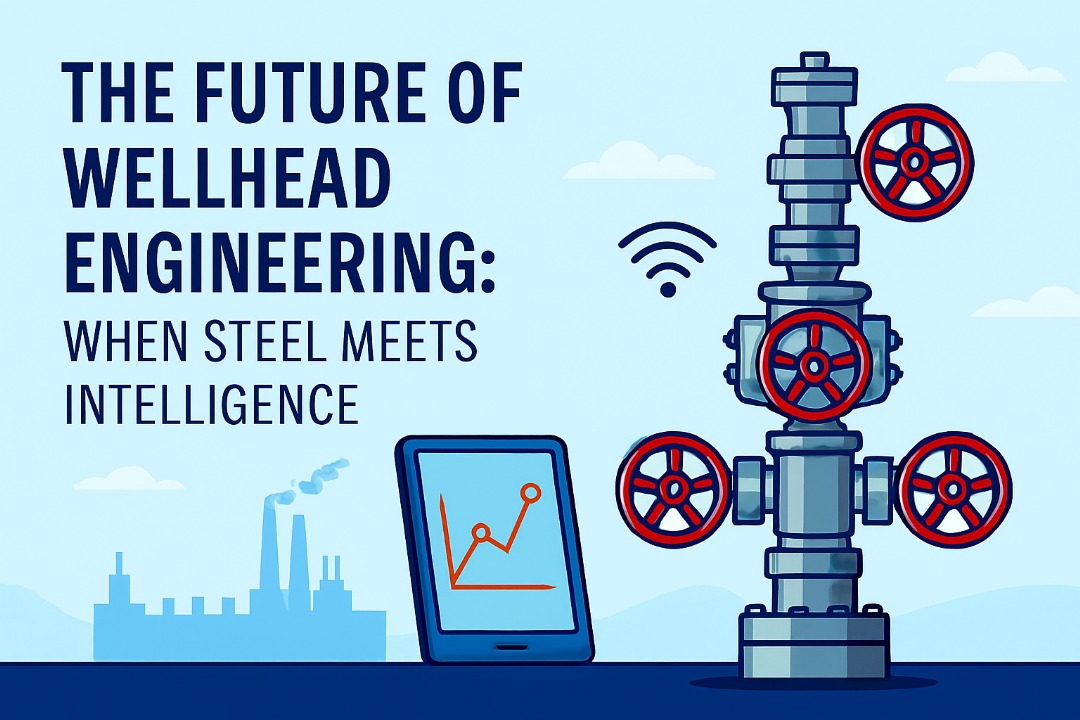
The Future of Wellhead Engineering: When Steel Meets Intelligence
- October 24, 2025
In October 2025, two global giants, Schlumberger (SLB)
and SBM Offshore announced a groundbreaking digital alliance aimed at
transforming offshore production systems through artificial intelligence (AI),
real-time data integration, and digital twins that can predict, optimize, and
prevent operational risks across subsea and surface systems.
At first glance, it’s another milestone in the digital
evolution of the oil and gas industry. But for those watching closely, it marks
a deeper shift, one that redefines how we think about wellhead engineering,
production reliability, and the skills required to sustain Africa’s energy
future (SLB, 2025).
From Hardware to Smart Systems
The traditional wellhead has long been a mechanical
masterpiece — a structure of valves, seals, and pressure-control equipment
designed to safely connect the reservoir to the surface.
Today, that static system is becoming a living,
sensing network.
Through the SLB–SBM Offshore collaboration, the
industry is moving toward connected ecosystems where data from subsea wells,
risers, flowlines, and topsides converge into an AI-driven digital twin (SLB,
2025).
This system doesn’t just report performance, it
learns, predicts, and advises.
- Imagine a wellhead that alerts engineers before a seal degrades.
- A subsea valve that adjusts automatically based on predictive flow
analytics.
- An offshore platform where maintenance is no longer reactive but
intelligently pre-planned through data modeling.
That vision is no longer distant — it’s the frontier
of engineering.
Why It Matters
The implications of this alliance go beyond
operational efficiency. It challenges the industry to rethink how offshore
assets are built, monitored, and managed.
1. Reliability through Intelligence
By merging SBM’s expertise in floating production
systems (FPSOs) with SLB’s Lumi™ data platform and Cognite’s AI technology, the
alliance delivers a continuous digital feedback loop from seabed to surface.
Every piece of equipment, including the wellhead, becomes a source of real-time
intelligence, not just a mechanical endpoint (SBM Offshore, 2025).
2. Predictive Maintenance & Sustainability
Predictive analytics can identify corrosion, fatigue,
or leaks before they occur, reducing downtime and environmental risk. This
aligns with the global shift toward sustainable, low-carbon operations,
ensuring safer and more efficient offshore performance (Erinjogunola, et al.,
2025).
3. Operational Integration
The concept of the “digital oilfield” is evolving into
intelligent, autonomous operations. It is no longer a buzzword. With AI-powered
insight and remote monitoring, engineering decisions can be made
collaboratively and instantly across continents.
The African Perspective: Potential and
Preparation
While the SLB–SBM Offshore alliance currently focuses
on projects in Brazil and the North Sea, its implications for Africa are
significant (SLB, 2025).
Africa’s offshore potential from the Gulf of Guinea to
Mozambique remains among the most dynamic frontiers for oil and gas
development.
However, most local operations still rely on limited
digital integration and manual inspection. This is both a challenge and an
opportunity.
By investing in digital infrastructure and training,
African producers could soon benefit from the same intelligent wellhead and
production monitoring systems, reducing downtime, improving safety, and
maximizing asset lifespan.
But that transformation depends on one critical
factor: human capacity.
Human Capital Development: The Missing Link
At PM4SUCCESS International, we emphasize that
technology alone doesn’t transform industries, people do. The evolution of
wellhead engineering calls for professionals who combine technical mastery with
digital fluency.
Tomorrow’s wellhead engineer must be able to:
- Interpret data patterns and apply predictive analytics.
- Collaborate with AI-enabled decision systems.
- Integrate mechanical, digital, and project management disciplines.
In other words, they will:
- Understand not just how systems work, but why they behave a certain
way through data patterns.
- Collaborate with AI interfaces to anticipate operational changes.
- Apply predictive analytics to optimize field performance and
safety.
- Manage digital workflows that connect mechanical engineering with
software intelligence.
This convergence of engineering, data science, and
leadership will define the future of oil and gas innovation in Africa. That’s
why Human Capital Development (HCD) isn’t just a support function, it’s the
foundation of the industry’s digital transition.
A Vision Forward
For Africa, the opportunity lies not in catching up,
but in building capacity that anticipates this transformation.
The SLB–SBM Offshore alliance offers a glimpse into
what’s possible when human expertise and technology converge. It’s a reminder
that the next wave of energy innovation will be driven not by more machines,
but by smarter integration between data, design, and decision-making.
It’s also a reminder that the next revolution in
wellhead engineering won’t be about stronger metals but about smarter systems
and smarter people.
For Africa, the hope is clear:
- To move from observers to participants in this transformation.
- To build capacity not only to install wellheads, but to interpret
their data, predict their future, and sustain their performance.
The future of wellhead engineering will belong to
those who can make technology not just work. It will not be defined by who can
build the strongest systems but by who can make them think, adapt, and evolve.
By PM4SUCCESS
Empowering Africa’s Energy Workforce through
Human Capital Development and Project Excellence.
#WellheadEngineering #DigitalOilfield #SLB
#SBMOffshore #AIinEnergy #OilAndGasInnovation #HCD #PM4SUCCESS
#EnergyTransition #PredictiveMaintenance #SubseaEngineering #SmartField
#FutureOfWork #CapacityBuilding #AfricaEnergy
References
- Erinjogunola, F. et al., 2025. Predictive Safety Analytics in
Oil and Gas: Leveraging AI and Machine Learning for Risk Mitigation in
Refining and Petrochemical Operations. World Scientific News, p. 93.
- SBM Offshore, 2025. SBM Offshore and Cognite Partner to
Accelerate AI and Data Collaboration to Optimize Floating Production
Operations. SBM Offshore, pp. 1-2.
- SLB, 2025. SLB and SBM Offshore Agree Digital Alliance to
Transform FPSO Production Performance. SLB, p. 1.